BEST MASKED SEXUAL EXPERIENCE - THE ICE STORM
The Ice Storm
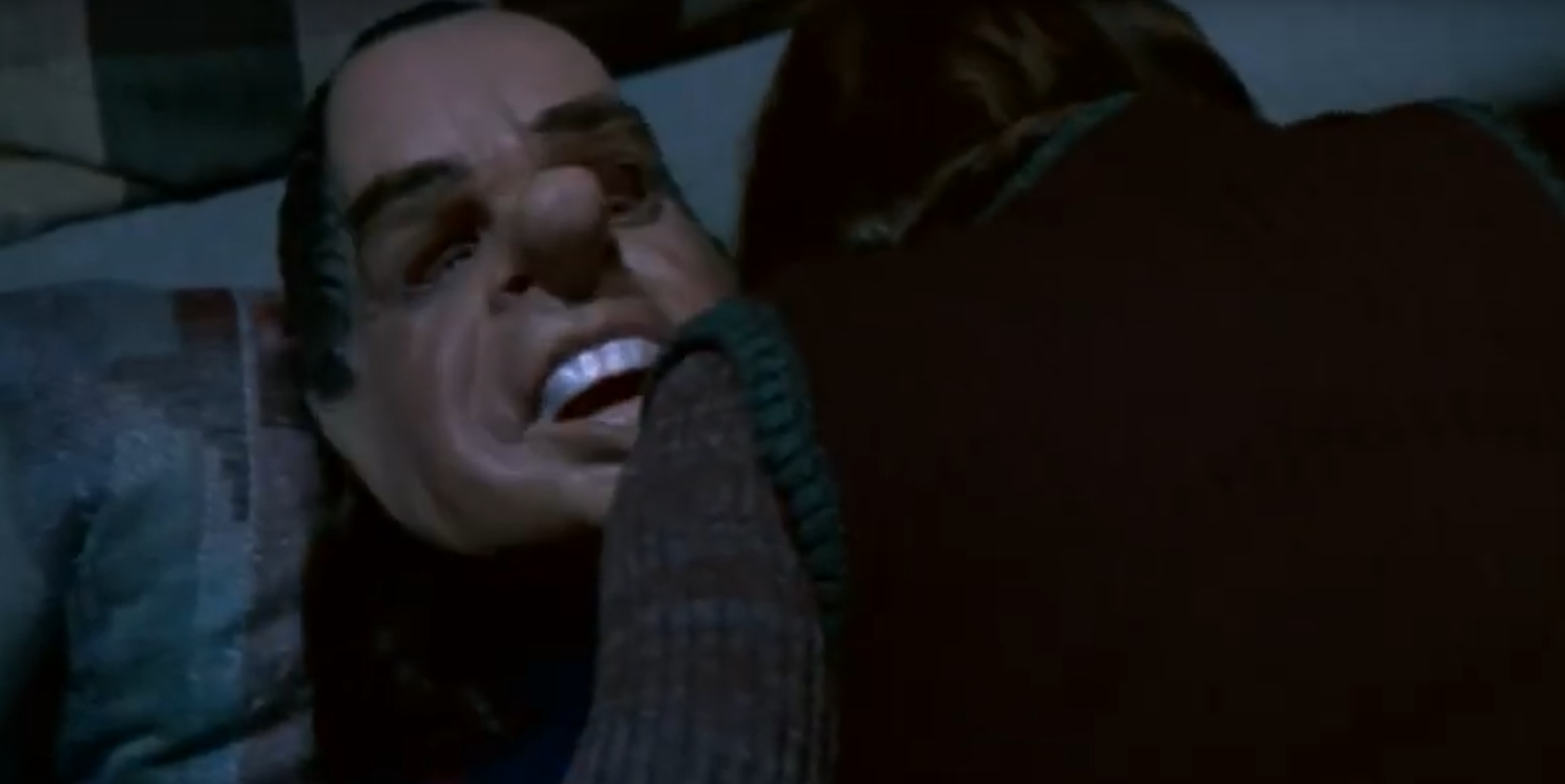
Congratulations to Ang Lee’s The Ice Storm (1997) for Christina Ricci and Elijah Wood's dysfunctionally off-kilter teen exploration session.
IDENTIFYING CINEMA’S BEST MASKED SEXUAL EXPERIENCE
Yeah, I know. I know! You’ve seen the winner of this category and you’re all aghast and agog thinking, ‘bu-but The Shining, the masterpiece, senpai Kubrick’s Shining, what about our lord and saviour’s masked sex scene?!’
You’re right. You’re right to stutter and stumble over your hyperbolic words, what about Kubrick’s The Shining (1980)?! Well…
First, to speak nothing of the merits of either scene, the elephant in the Itty Bitty room is semantics. Naturally the Kubrick hotel room scene springs to mind when going through your mental catalogue of masked sexual encounters but, unlike the hideous likeness of Ronald Regan, would your first instinct really be to call it a mask?
The Shining (1980)
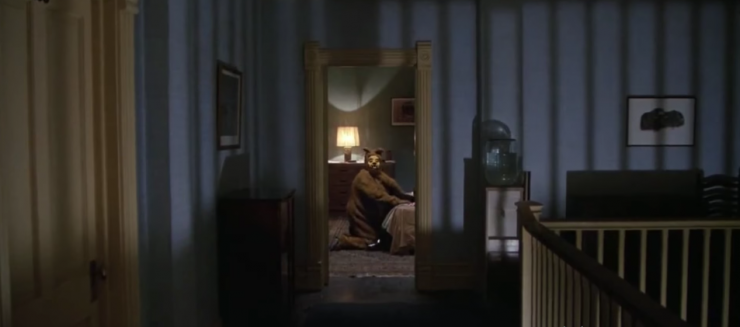
This, framed in iconic Kubrickian symmetry, is a bear suit.
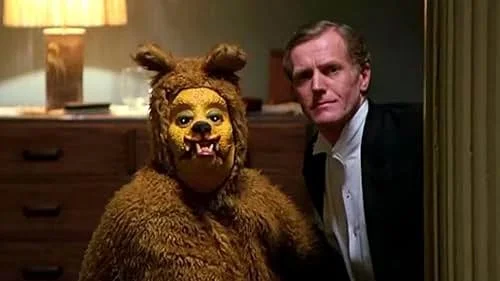
While an argument could be made that a mask is indeed part of the suit, and thus the scene constitutes a masked sexual encounter, this is much the same as looking at a car and calling it a wheel.
That said, whatever side of the semantic fence you fall, it equally wouldn’t be entirely wrong to give the Best Masked Sexual Experience to The Shining.
So, in the interest of true competition, let’s talk about both scenes.
The Shining’s Bear suit scene
Running around the Overlook Hotel to an unsettling score, Wendy (Shelley Duvall) stumbles upstairs calling out for her son, Danny. As she reaches the next floor, clutching a giant kitchen knife, she sees a slither of a scene inside a hotel room: the bare naked arse of a man kneeling over a bed in furry brown trousers, the feet of another man dangling beside him. Alerted to her presence, the two men sit up, pausing their implied sexual act, revealing one wearing a full bear suit and the other in black tie. We cut to a medium close-up of the men, as they both stare at Wendy, emotionless.
The bear suit scene, admittedly, is exponentially more recognisable than dry-humping Nixon. People who saw The Shining once in 1984 still remember the bear suit, the carpet, and Shelley Duvall’s world-class, palpable fear.
The bear suit scene has escaped the confines of The Shining to be a pop culture moment in its own right, with Kubrick fans clawing over the scene like Nolan fans thrown a spinning top.
“WHAT COULD IT MEAN, STANLEY, YOU BRILLIANT BASTARD!? HALF A SECOND OF BEAR SUIT FELLATIO MUST MEAN SOMETHING!”
While I’m forever grateful to Kubrick for taking a break from filming all that moon-landing stuff to explore his furry side, this is one instance where I think the reaction to the scene itself doesn’t necessarily reflect the fundamentals of the scene.
If we were writing a 300-page dissertation, we could delve into myriad theories about what the bear suit symbolises in the context of The Shining. All fascinating, all reasonably argued, some heavy, but none confirmed.
Let’s be clear: other than itty-bitty moments and ambiguous endings, there’s little I love more than a scuffle over hidden meanings. I think the nature of the discussion around the bear suit is top-notch, absolutely raising the bear suit scene’s stock value. But there’s one little rusty cog eroding my enjoyment: the bear (dog) scene is in the source material.
Stephen King, famously not a fan of Kubrick’s adaptation, wrote the scene, and Kubrick kept it in. Applying Occam’s razor, that really is all she wrote.
Kubrick removed a lot of details from King’s original story, especially self-inserts, deeper exposition, and notably reworking the ending. In doing so, Kubrick created a very different experience inside the Overlook Hotel. Something Kubrick did keep, however, is the bear scene. In King’s original work, we learn about a dude with a humiliation kink who dressed up in a dog suit for a party. Beautiful fan theory notwithstanding, for official purposes, we have to assume Kubrick just liked it and thought it would be a great, tonally fitting addition to his retelling.
As always, he was right.
The Ice Storm’s Ronald Regan mask scene
In The Ice Storm, set in 1973 Connecticut, two neighbouring families spend a Thanksgiving weekend swollen with affairs, deceit, and teenagers. Ben Hood (Kevin Kline) is cosying up to Janey Carver (Sigourney Weaver), while his wife Elena (Joan Allen) observes the death of their marriage. Everything comes to a head during a suburban key party, just as an ice storm hits, bringing everything to a boil... coldly.
Due to a difficulty letting things go, I want to open this breakdown of The Ice Storm’s masked sexual experience with a note about both this scene and the bear suit: these are not titillating scenes.
Neither of these “sexual experience” award contenders is sexy. Both are gloriously off-putting. I can’t think of anything more boring than a sexy sexual experience (until we get to those awards, for one sexy sex can be more interesting than another sexy sex, but rarely can a sexy sex be more captivating than an unsexy sex), and that’s why we’re sitting here dissecting bear head and Ronald Regan.
The manipulation of discomfort is infinitely more valuable to me in film than hot people doing hot stuff. That’s easy; it’s Hollywood. But discomfort, that’s special. Very distinct from disgust, which is also relatively cheap, discomfort has such a rich payoff.
Discomfort me.
I beg to be cinematically discomforted.
Ronald Regan’s phallic nose, uselessly erect, commanding the eye as an awkward Elijah Wood dry humps a rigid Christina Ricci, radiates an agonising perfection with which no bear suit could compete. This is years of awkward sexual teen discovery condensed into one shut-in during an ice storm. Not only are they fully clothed, but there are sweater vests involved. There’s a lot of courderoy. It’s an amalgamation of the least sexy fabrics in their least attractive forms, layered upon one another, not only denying the prospect of skin-on-skin but making it an arduous impossibility.
And let me reiterate, this is Elijah Wood and Christina Ricci. That’s Icon Wood and Icon Ricci to the likes of us.
Going into The Ice Storm, Frodo wasn’t yet on the table for Wood, but he’d had an extraordinary run as a child actor before Peter Jackson swooped in with The Lord of the Rings. Wood’s early rap sheet includes: Paradise (1991), Radio Flyer (1992), Forever Young (1992), The Good Son (1993), North (1994), The War (1994), and Flipper (1996), to name a few from my childhood cinematic universe. We all remember Macaulay Culkin as the child of the 90s, but Elijah Wood was right there with him every step of the way (sometimes literally, re: The Good Son).
Entering The Ice Storm, Christina Ricci was fresh out of the universally beloved smash-hit Casper (1995). She was also our Wednesday Addams. ‘Our’, in this case, refers to those of us old enough to reel off Elijah Wood’s early film career.
The Ice Storm is of a moment, so deeply unsung, that writing this makes me feel a deep sense of injustice for Ang Lee. Why don’t we all talk about The Ice Storm? Don’t we, the hive-mind, love awkward suburban kooky debauchery? If you slapped an A24 ident in the paratext and released it in 2020, we’d all still be yapping about it.
ANYWAY, TO CONCLUDE
I’ve been to Comic Cons, I’ve lived Wendy’s bear experience. However, a Ronald Regan dry-hump wearing various shades of thickly woven brown, in a tense 70s suburban minefield of repression, it just hits so much meatier.