Caveat
Caveat (2020) is a solid debut feature from director Damian McCarthy, who went on to make the very watchable Oddity (2024) but, to my surprise, had nothing to do with 2018’s Possum. So if, like me, you were thinking those three movies would make an impressive auteurial triptych, you’re correct. They would. They’re just, you know, not.
Anyway.
In my never-ending quest to be safely disturbed, I decided to revisit Reddit’s horror movie threads. If you’re familiar with Reddit horror movie recommendations, you’ll know they typically throw out the same 15-20 recommendations every thread, adding a couple every year, forgetting a couple every year.
The two most popular additions to the Reddit horror pantheon from the 2020s are When Evil Lurks (2023) and The Dark and the Wicked (2020). You’ll see these recommended a few times each in the weekly ‘Guys, seriously, what’s a horror movie that REALLY scared you?’ post.
Then Caveat started to appear. Not as reliably, nor with such gusto, as When Evil Lurks, but enough to commit to memory.
One thing I noticed about Caveat enjoyers was that they liked to add a little note about Caveat with their recommendation:
That one scene. There’s this one scene. That one bit. I couldn’t watch that one scene.
I reached out to a good friend and asked if he’d seen Caveat. He hosts movie nights on Discord, and I thought it could be a good pick. Turns out he had already seen it, and it came with his approval. So I watched it. Adhering nicely to social convention, I reported as much to my Discord-movie-night friend. I told him I thought it was enjoyable but not scary.
He said: What about that one scene?
I said: WHAT FUCKING SCENE?!
That one scene
Spoilers, obviously.
So, here’s the crux of all this.
In Caveat, there are a lot of tension-filled scenes. It’s a film where, the entire time, you’re mildly grimacing; not really from fear, but with a protracted sigh and slight grimace as the protagonist does the exact opposite of someone with an average IQ and mild survival instinct at every opportunity.
After over an hour of things getting slowly worse, we get to that one scene.
The protagonist has fled his captor and ended up inside a tiny, hidden area behind a wall in the scary basement.
This tiny, hidden area is slightly exposed from an antagonist making a fist-sized hole in the wall earlier.
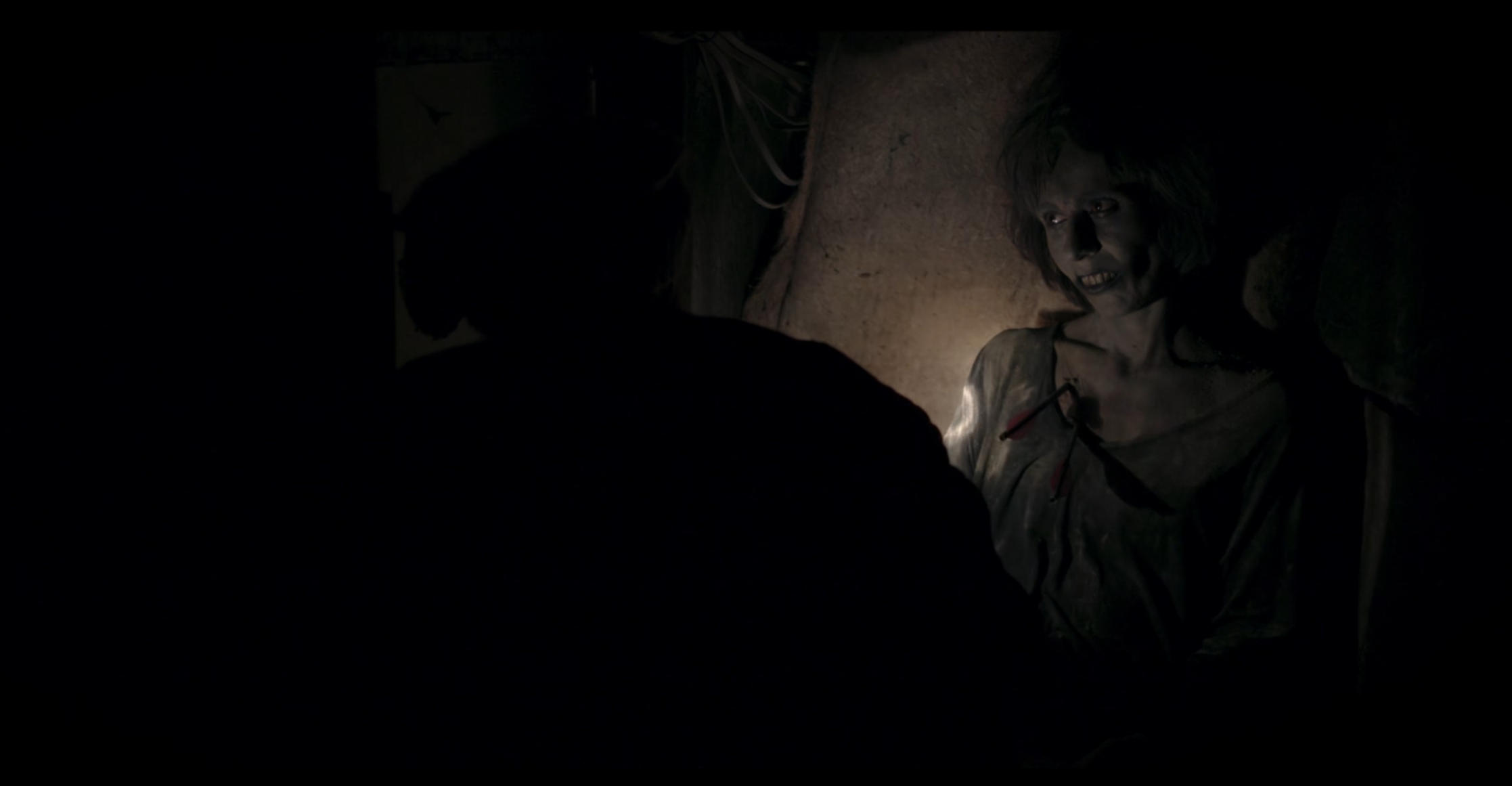
In this cupboard-sized room, there is a body, sitting up, facing the protagonist.
The protagonist must cut his way out of this space, in the pitch black, with only the directional light of his flashlight.
The protagonist shines his flashlight on the hole he is sawing through the wall, but periodically stops to shine light back onto the body to make sure it hasn’t moved.
Unnerved, he puts a tea cosy he had been wearing as a hat over the body’s face.
He goes back to cutting.
He shines the torch back at the body, the tea cosy has moved to reveal the eye of the body looking out through a hole.
Credit where credit is due, the scene in isolation is executed really well. After an hour of mounting tension and questions about what the hell has been going on in this weird, isolated house, this scene has every right to be an incredibly tense, watch-through-your-fingers moment.
But it’s not. It can’t be.
Since watching Caveat, I’ve been stumped as to why audiences react the way they do to this scene, and I can’t tell what the filmmakers' intentions were.
Here’s why:
The scene preceding it shows the protagonist trapped in a bathroom, injured and useless, a pathetic creature curled up on the floor, held captive by an unstable woman with a crossbow. He is then RESCUED by the body. It appears to him, showing him a way through the wall in the house. He follows it and ends up behind the basement wall, where the body’s location had been established earlier in the film.
It is, quite clearly, a friendly body.
My take from the scene was comic relief. The protagonist doesn’t trust the body. Why would he? He doesn’t know he’s operating within the rules of universe-building and storytelling. As an audience, we’re watching some comic relief: the tea cosy, the peeping, the back-and-forth of the torch. This is a funny moment. There’s no actual tension from anything other than time ticking down before the antagonist discovers where he is.
If we trust the filmmakers, we trust the body.
So, should we trust you, Damien?
I really, really want to know what the intention of the scene was.
Did the filmmakers pray for a lack of media literacy in audiences, assuming they’d instantly forget the body just helped the protagonist?
Was it just comic relief, and a lack of media literacy turned it into something unintended?
Was it bad storytelling? Did the filmmakers accidentally undermine their own tension?
My thoughts (probably wrong, but I have them anyway)
I think it’s a little column A, a little column B.
I think the filmmakers needed to reveal that the body was sentient and, by virtue of wanting revenge on the antagonists, willing to help the protagonist. Not wanting to reveal their hand too early to keep the unknown palpable, they didn’t want to slap the friendly body reveal in act 2. However, they also can’t just plop the friendly body reveal at the very end because that would feel cheap, and there would be no dramatic tension when the antagonists interact with the hidden space. So they settled on this spot to help push the narrative forward and set us up for the finale. Sadly, however, this reveal comedically transformed what could have been one of the most memorable horror movie scenes of 2020.
But maybe it still was.